Willow Creek’s “Confession”

File this under the “I could have told you that” category.  (Article Here)

Willow Creek mega church as done a self-study and realized that their seeker sensitive approach draws huge crowds….but doesn’t make strong disciples.

I would think that was pretty obvious.  If your program is based only on “felt needs” and meeting people where they are, how can you address real but un-felt needs and grow people to where they need to be?

CHAP. XIX. The Parson in reference. CHAP. XIX. The Parson in reference.

THe Countrey Parson is sincere and upright in all his relations. And first, he is just to his Countrey; as when he is set at an armour, or horse, he borrowes them not to serve the turne, nor provides slight, and unusefull, but such as are every way fitting to do his Countrey true and laudable service, when occasion requires. To do otherwise, is deceit; and therefore not for him, who is hearty, and true in all his wayes, as being the servant of him, in whom there was no guile. Likewise in any other Countrey-duty, he considers what is the end of any Command, and then he suits things faithfully according to that end. Secondly, he carryes himself very respectively, as to all the Fathers of the Church, so especially to his Diocesan, honouring him both in word, and behaviour, and resorting unto him in any difficulty, either in his studies or in his Parish. He observes Visitations, and being there, makes due use of them, as of Clergy councels, for the benefit of the Diocese. And therefore before he comes, having observed some defects in the Ministry, he then either in Sermon, if he preach, or at some other time of the day, propounds among his Brethren what were fitting to be done. Thirdly, he keeps good Correspondence with all the neighbouring Pastours round about him, performing for them any Ministeriall office, which is not to the prejudice of his own Parish. Likewise he welcomes to his house any Minister, how poor or mean soever, with as joyfull a countenance, as if he were to entertain some great Lord. Fourthly, he fulfills the duty, and debt of neighbourhood to all the Parishes which are neer him. For the Apostles rule Philip. 4.[8] being admirable, and large, that we should do whatsoever things are honest, or just, or pure, or lovely, or of good report, if there be any vertue, or any praise, and Neighbourhood being ever reputed, even among the Heathen, as an obligation to do good, rather then to those that are further, where things are otherwise equall, therefore he satisfies this duty also. Especily, if God have sent any calamity either by fire, or famine, to any neighbouring Parish, then he expects no Briefe; but taking his Parish together the next Sunday, or holy-day, and exposing to them the uncertainty of humane affairs, none knowing whose turne may be next, and then when he hath affrighted them with this, exposing the obligation of Charity, and Neighbour-hood, he first gives himself liberally, and then incites them to give; making together a summe either to be sent, or, which were more comfortable, all together choosing some fitt day to carry it themselves, and cheere the Afflicted. So, if any neighbouring village be overburdened with poore, and his owne lesse charged, hee findes some way of releeving it, and reducing the Manna, and bread of Charity to some equality, representing to his people, that the Blessing of God to them ought to make them the more charitable, and not the lesse, lest he cast their neighbours poverty on them also.
We are not alone, as Christians, as Citizens or in whatever vocation we have been called to.  Although I don’t understand the specifics Herbert is referring to in part of this chapter (did Country Parsons take up arms in time of war?) it is obvious that Herbert is having us consider our obligations and responsibilities to, as well as our assistance and benefits from the network of relations we have.  It would be good for us to consider what we owe to our country and community, as well as our fellow pastors and to all the baptized.  How would our communities benefit if ministers, regardless of denomination were to welcome one another as a ‘great Lord’ instead of gossip about ‘those’ churches.  Or think of the benefit smaller congregations would gain if larger churches with more resources and wealth were to be charitable as to a neighbour as Herbert suggests.  Herbert has a good message for us modern American churches who think very much of our individual lives and individual congregations.

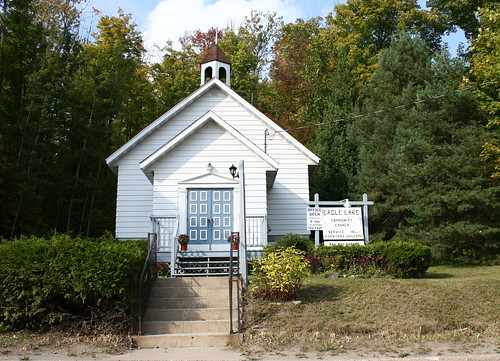
(Image is Eagle Lake Community Church by Vitoden)
CHAP. XVIII. The Parson in Sentinell.

THe Countrey Parson, where ever he is, keeps Gods watch; that is, there is nothing spoken, or done in the Company where he is, but comes under his Test and censure: If it be well spoken, or done, he takes occasion to commend, and enlarge it; if ill, he presently lays hold of it, least the poyson steal into some young and unwary spirits, and possesse them even before they themselves heed it. But this he doth discretely, with mollifying, and suppling words; This was not so well said, as it might have been forborn; We cannot allow this: or else if the thing will admit interpretation; Your meaning is not thus, but thus; or, So farr indeed what you say is true, and well said; but this will not stand. This is called keeping Gods watch, when the baits which the enemy lays in company, are discovered and avoyded: This is to be on Gods side, and be true to his party. Besides, if he perceive in company any discourse tending to ill, either by the wickedness or quarrelsomnesse thereof, he either prevents it judiciously, or breaks it off seasonably by some diversion. Wherein a pleasantness of disposition is of great use, men being willing to sell the interest, and ingagement of their discourses for no price sooner, then that of mirth; whither the nature of man, loving refreshment, gladly betakes it selfe, even to the losse of honour.

As with the last chapter, Herbert reminds us that a minister is a minister always.  Here he reminds pastors that others will watch their reaction in conversations, wherever they take place.  A minister’s duty of oversight and teaching continues whether the discussion is in the Church hall, at a party or in the marketplace.  Although Herbert tempers his instructions by reminding the parson to be discrete, we probably are tempted to see the ideal of a minister correcting others and always ready to ‘test and censure’ as an overbearing busybody.  But consider the witness it would be for ministers to politely correct errors instead of tacitly approve of them.

Miller Beer associates itself with an event mocking the Last Supper of Jesus

I was appalled to see this article this morning.  I know I shouldn’t be surprised anymore, but after I get over my initial shock I’m always angered by the hypocrisy in our society when it comes to attitudes towards Christians.  If there had been a poster or comment even half as offensive toward Jews, Muslims, ethnic minorities or homosexuals this story would be a major headline and Miller would be offering serious apologies.

CHAP. XVII. The Parson in Journey.

THe Countrey Parson, when a just occasion calleth him out of his Parish (which he diligently, and strictly weigheth, his Parish being all his joy, and thought) leaveth not his Ministry behind him; but is himselfe where ever he is. Therefore those he meets on the way he blesseth audibly, and with those he overtakes or that overtake him, hee begins good discourses, such as may edify, interposing sometimes some short, and honest refreshments, which may make his other discourses more welcome, and lesse tedious. And when he comes to his Inn, he refuseth not to joyne, that he may enlarge the glory of God, to the company he is in, by a due blessing of God for their safe arrival, and saying grace at meat and at going to bed by giving the Host notice, that he will have prayers in the hall, wishing him to informe his guests thereof, that if any be willing to partake, they may resort thither. The like he doth in the morning, using pleasantly the outlandish proverb, that Prayers and Provender never hinder journey. When he comes to any other house, where his kindred, or other relations give him any authority over the Family, if hee be to stay for a time, hee considers diligently the state thereof to Godward, and that in two points: First, what disorders there are either in Apparell, or Diet, or too open a Buttery, or reading vain books, or swearing, or breeding up children to no Calling, but in idleness, or the like. Secondly, what means of Piety, whether daily prayers be used, Grace, reading of Scriptures, and other good books, how Sundayes, holy-days, and fasting days are kept. And accordingly, as he finds any defect in these, hee first considerswith himseife, what kind of remedy fits the temper of the house best, and then hee faithfully, and boldly applyeth it; yet seasonably, and discreetly, by taking aside the Lord or Lady, or Master and Mistres of the house, and shewing them cleerly, that they respect them most, who wish them best, and that not a desire to meddle with others affairs, but the earnestnesse to do all the good he can, moves him to say thus and thus.

Herbert understands that the minister is always a minister, even in travelling he is to continue his ministry as the occassion provides – blessing and ministering to strangers, continuing in his regular rule of prayer and (if appropriate) overseeing his guest home like his own.   Sometimes I enjoy the anonymity of travel, but Herbert reminds me that the ministry is not something we leave when we leave the border of our parish.  God can provide opportunities for ministry wherever we go.