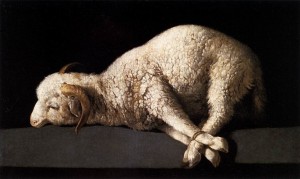
The next day [John the Baptizer] saw Jesus coming toward him, and said, “Behold, the Lamb of God, who takes away the sin of the world! (John 1:29)
The Bible makes it clear that Jesus’ suffering on the cross was not merely a great injustice in the death of an innocent man, or the tragically short end to the life of a captivating moral teacher. Jesus’ death on the cross was the culmination of his ministry, he himself said just before he was betrayed into the hands of the Roman officials “Now is My soul troubled; and what shall I say? Father save Me from this hour: but for this cause came I unto this hour.” (John 12:27) His death was a sacrifice that freed His people. Just as the passover, the sacrifice that marked God’s people with the blood of the lamb, celebrated Israel’s liberation from bondage to Egypt, the death of Jesus, “the lamb of God”, marks us as those who are liberated from sin and death.
John notes several details about the crucifixion to remind his readers that Jesus is the one who is the ultimate passover lamb. Many points of his narrative coincide with the details of the sacrifice given in Exodus 11 and 12. The chronology in John’s Gospel tells us that the crucifixion took place at the time the lambs were being slaughtered for the sacred meal. John 20:25-27 tells us that Jesus was looking after the well being of his mother, in doing so we are reminded that he was her firstborn – in the Exodus, the firstborn of those not marked with the lamb’s blood were killed by the final plague. In v. 29, we are told that a hyssop branch is used to give Jesus a final drink to quench his thirst, this is reminiscent of the hyssop used to mark the door posts in Exodus 12:22. We are also told in detail that Jesus’ bones were not broken during his execution, an explicit requirement for preparing the passover meal. (Ex. 12:46) John masterfully reminds us through his telling of the Lord’s passion what Paul writes in I Corinthians 5:7-8, “Christ, our Passover lamb, has been sacrificed. Let us therefore celebrate the festival”.